
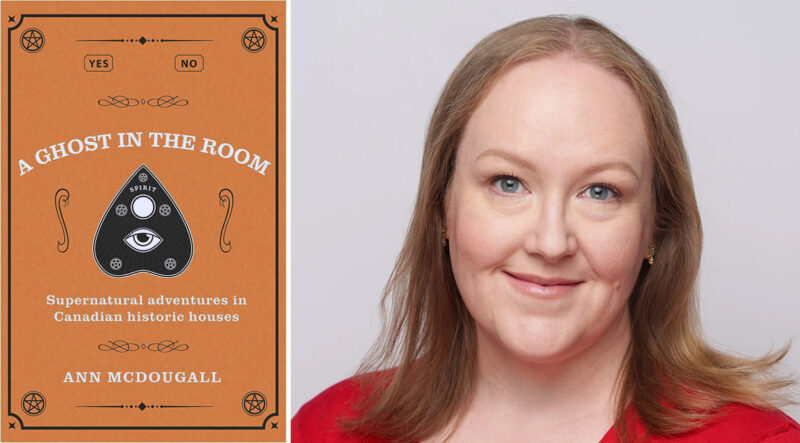
Ann McDougall spent a good portion of her career working as a host in museums like the Spadina House and Todmorden Mills in Toronto, and the one question that always came up was, “Is it haunted?”
“To be honest, my answer was usually no,” she admitted during a Zoom conversation in March. “It’s not like I was having experiences myself, but it kind of didn’t matter because people wanted to talk about ghosts.”
They also wanted to share their ghost stories.
“Over time, I got really curious about why this is so important to people,” McDougall said. “Why is there so much to say about this topic? And what is it about historic houses and museums, especially, that brings this out in people?”
McDougall began to research the subject in earnest and soon found herself down a rabbit hole. What she eventually surfaced with was her book A Ghost in the Room: Supernatural Adventures in Historic Houses. It explores our fascination with ghosts and the paranormal by connecting traditional stories from individual museums with her own research into how believers, fraudsters and skeptics engage with the other side.
“You’re really confronted by history,” she said. “It’s very physical. You’re in their rooms. You’re looking at their stuff. You’re in these very intimate spaces, like their bedroom or their kitchen, and I think for people, that really brings to mind these deep questions about what happened to these people, what happens when life ends?
“The great thing about a museum is that it’s a place where people, especially adults, feel comfortable asking questions. There aren’t that many spaces like that in the modern world where we let adults be curious and open to ideas.”
Some of the locations featured in the book are the Mackenzie House Museum in Toronto, Fulford Place in Brockville, Black Creek Pioneer Village in North York, Beaconsfield Historic House in Charlottetown, Todmorden Mills, Homer Watson House, the Macdonald Farmhouse (Fire-Spook) in Caledonia Mills, Nova Scotia, Fort La Reine Museum, Quesnel and District Museum and Fort William in Thunder Bay.
A skeptic by nature and guided by science, her mind was partly changed during the course of the book’s production.
“Because I hadn’t had those experiences when I went into it, I had this idea in my head that paranormal investigators and people who were into the supernatural were maybe exaggerating — maybe making things up,” she admitted. “Then I realized that’s not it. People really do have these experiences that are very real … and they’re really just trying to figure out the world that they’re in.”
When she was younger, McDougall did get annoyed by all the talk about ghosts in museum workplaces, but as she got older, she came to see it differently, realizing it reveals something about our culture and who we are as people.
The Spiritualist movement of the mid to late 19th century was something that really caught her attention, especially the story of Toronto resident John Saunders, who met his Waterloo at a séance in the late summer of 1874.
The 31-year-old, who was interested in spiritualism, attended a séance above Morrison’s clothing store on King Street with a medium named Walker. After collecting a few details from Saunders, the medium disappeared into the spirit cabinet. As the séance began, a fire broke out. Saunders rescued the medium and, in the process of sweeping what he thought were burning coals into a bowl of water, his hands caught fire.
The coals were actually white phosphorus, a waxy substance that glows eerily green and is highly flammable. Saunders’ hands caught fire and he was taken to the hospital. He initially responded well to treatment, but on September 30, he developed lockjaw from a tetanus infection. He died on October 6. An investigation was eventually launched into the affair.
Charlatans like Walker aside, the interest in the paranormal did lead to scientific discoveries during that time period, including Dr. Michael Faraday’s discovery of the ideomotor effect, the subconscious motions of a person during table-tipping, and Dr. Hans Berger’s discovery of brain waves while searching for physical evidence of telepathy.
“There’s this idea that it’s not serious because it’s paranormal stuff,” she said. “I think after writing this book, I want to push back against that notion a little bit because it’s true. There are a lot of sincere people who are just trying to understand their own experiences and these are common experiences.”
A Ghost in the Room: Supernatural Adventures in Historic Houses was published in October 2025 by Tidewater Press in British Columbia. It’s available to purchase at your local bookstore or wherever else you buy your books.