
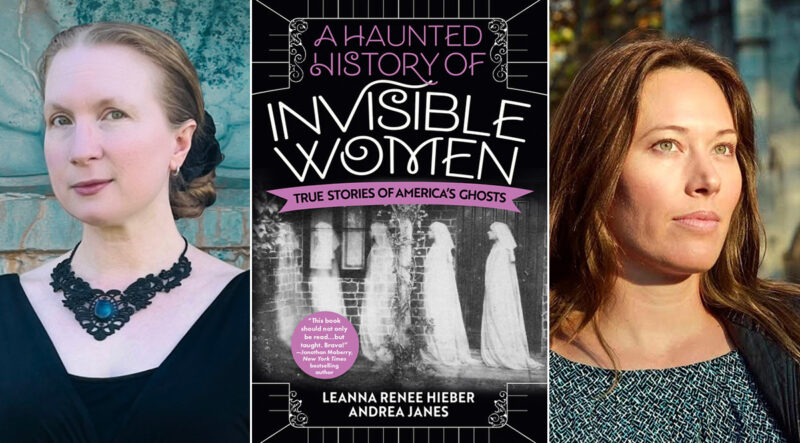
I’ve been on a bit of a kick lately, exploring different cultures’ interpretations of the Woman in White trope.
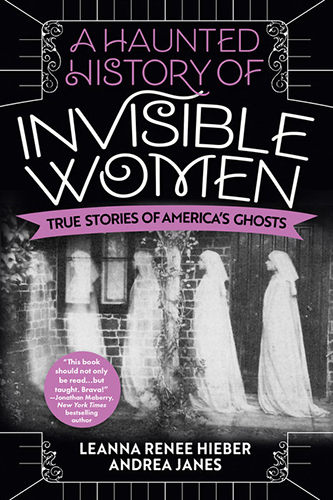
Invisible Women: True
Stories of America’s Ghosts
By Leanna Renee
Hieber and Andrea
Janes
Citadel Press
New York, 2022
I even talked it up while visiting Thunder Bay and Halifax as a guest speaker at two conventions. So it seemed timely that I should pick up A Haunted History of Invisible Women: True Stories of America’s Ghosts by Leanna Renee Hieber and Andrea Janes.
I’m glad I did.
Admittedly, I first came across it when paranormal investigator Alex Matsuo mentioned it on social media. Around the same time, I pitched a story to Haunted Magazine about the long history of women contributing to the paranormal but still getting short shrift.
Invisible Women became the book that helped me polish that winter feature and maintain my optimism about the paranormal sphere.
Let me expand on that last note. As a skeptic, I appreciate books about the paranormal that explore why ghost stories exist and how they reflect who we are as a society. It’s the same social anthropological lens I used when I wrote my own book.
Ghostland: An American History in Haunted Places by Colin Dickey was my first “wow” read in that vein.
Don’t get me wrong. I’m all for volumes of campfire ghost stories. But we also need books that explore why ghost lore exists and how the narratives in those stories reflect who we are as a culture.
An added bonus is that it satisfies my curiosity about the Woman in White trope.
Hieber and Janes perform a kind of spiritual cleansing in their deconstructions of America’s more infamous female ghosts. They remind readers that women are layered, nuanced and actual people, much to the disappointment of the misogynists out there.
With wry humour and personal reflection, the two volley their thoughts back and forth on the tropes of maidens, “witches”, mothers, wives, jezebels, murderesses, “madwomen”, spinsters, widows and charlatans.
They share the briefest versions of ghost stories but focus more on the deconstruction. They expand on Kate Morgan of the Hotel del Coronado, acknowledge that Mary Surratt may have played a role in the assassination of Abraham Lincoln and go to bat for Sarah Winchester, who was largely a victim of her time. She was interested in architecture, but was only allowed to pursue that passion by expanding her own home.
There is a lot to parse through in the book’s more than 300 pages. Still, it offers a thoughtful look at how women were, and in many cases still are, expected to fit into an unrealistic cookie-cutter mould.
It also feels timely, given the social about-face the United States has taken under its current kakistocracy, I mean administration.
Many of those societal shifts began during a particular world leader’s first term, especially with the unravelling of Roe v. Wade.
I don’t want to transition away from such heavy matters quickly, but I will say this book is a must-read for anyone interested in how the ghost story sausage is made and the cultural impact those narratives can have.
It grapples with America’s history of slavery and the mistreatment of women. It also highlights one of the few avenues where women had agency in the 19th century: Spiritualism.
One final note. This is also a book that pushes back against the idea that the paranormal isn’t political. Any investigator or tour guide who has dug through the annals of history knows our ghost stories are rooted in politics, whether it be residents of Salem witch trials accusing women of witchcraft to obtain their land or clandestine plots to assassinate the president during the American Civil War.