
Have you ever been lost in the body of a book and wanted to venture yonder, to travel to the places you pore over?
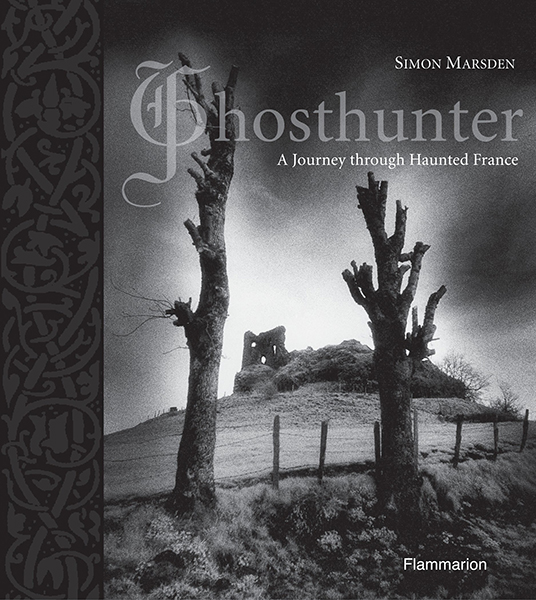
Haunted France
By Simon Marsden
Flammarion
Paris, 2006
Ghosthunter: A Journey Through Haunted France by Simon Marsden, with complementary prose fit for a diary in an Arthur Machen or Edgar Allan Poe novella, has sparked a deep sense of wanderlust in me.
The book unfolds with Marsden’s own paranormal Tour de France in the fall of 2005, from Paris to Arles and all points between. It reads like the beleaguered narration of a Poe protagonist, sharing his concerns in true Gothic fashion.
But that’s not all. Marsden is a well-known British photographer, recognized for his eerie architectural images.
I’ve experienced something of a renaissance with his work. For years, my uncle bought me the Haunted Realms calendar, which often featured Marsden’s photography. That hidden, veiled style, indicative of the infrared film he used, felt magical.
My first exposure came through the Time-Life Books series of the 1980s. Mysteries of the Unknown: Phantom Encounters opened with Marsden’s haunting images. I touch on that in an upcoming feature for Haunted magazine, where I highlight one of my favourite photographers.
But he’s a writer, too. Having explored the works of Machen, M. R. James and Poe, I felt as though I was travelling the French countryside with a good friend. His knowledge of Catherine de’ Medici, the Knights Templar, the Hundred Years’ War, Joan of Arc and the nobles of France’s darker days is rich and immersive.
He explores these moments with a sense of unease, often hinting at his trepidation in the locations he photographs. He recounts the slaughter of the Cathars during the Albigensian Crusade and delves into one of my favourite paranormal themes, La Dame Blanche, offering insight into the French interpretation of the wandering spectre.
“A lost soul who comes to lament her unfulfilled destiny,” he writes while visiting Château de Bonaguil. “White was also the colour of a corpse’s shroud and it’s traditionally thought of as the colour of death and mourning.”
French queens often wore white once they became widows. He points to Louise of Lorraine, who adopted the colour after the death of Henry III of France.
There is so much history in this book, and the landscapes are marvellous. At times, though, my Monty Python-raised mind can’t help but wander to Monty Python and the Holy Grail, flashing to John Cleese as the taunting French knight atop Doune Castle.
Still, the blend of Gothic diary narrative, Marsden’s deep knowledge of French history — he studied there — and, most importantly, his photography, creates something memorable.
He closes his journey along the Allée des Sarcophages, pausing to consider life and death as the remnants of the Roman Empire seem to look on.
“I would like to discover exactly what ghosts are,” he writes, “but my obsession with photographing sites such as this is beginning to make me question whether part of the answer lies within me, and whether I am, for whatever reason, a haunted man.”