
With National Acadian Day, or Fête nationale de l’Acadie, fast approaching on August 15, it seems like a good time to explore some of New Brunswick’s lore — the kind that still draws plenty of attention long after a poet’s tale.
The legend of the Dungarvon Whooper (pronounced “hooper”) runs like a river through the communities from Doaktown all the way up to Renous and, inevitably, Miramichi.
The near-century-old tale has never suffered a cultural drought. Organizations such as the Miramichi Folklore Park and the Miramichi Heritage Players help keep it alive.
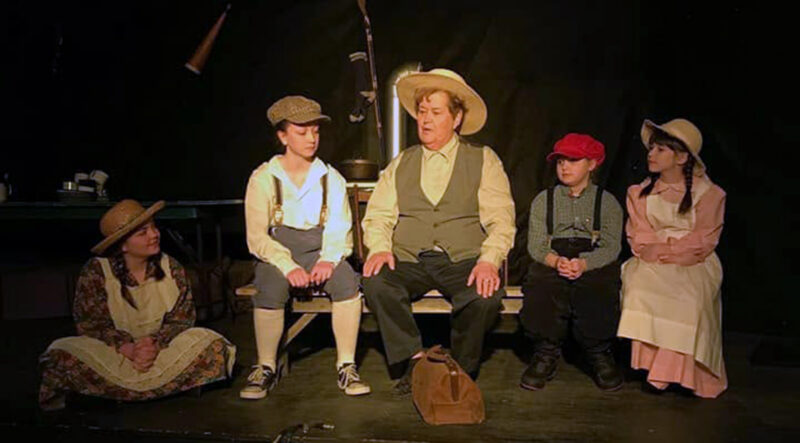
Bernie Colepaugh, artistic director of the players, adapted a play from Michael Whalen’s 1912 poem The Dungarvon Whooper.
“We got together with a few people and I ended up writing it, I was in it and I also directed it,” he said during a phone conversation earlier this year. “We did that and we went on to do quite a few other plays based on local legends and stories.”
Whalen was Colepaugh’s great-great-uncle — his grandmother’s uncle. Colepaugh grew up with Uncle Mike around the house often.
“We got interested in telling the story,” he said. “It was going to be a one-off, but we received such a great reception for the play that we went on to do a Peter Emberley, a John Connell and a Yvonne Durelle.”
All the plays draw on Miramichi legends. The company has performed the Dungarvon Whooper play 19 times, including one recent production with an all-female cast.
Dale Manderville acted in several of the dinner-theatre versions.
“It was a dare from my son who was 10 years old at the time and he kind of cornered me into doing it,” he said. “I enjoyed it after a while, but anything that takes you out of your normal routine is a good challenge.”
For Colepaugh, the Dungarvon Whooper is part of the fabric of the community and brings people together — including Manderville.
“It’s our ghost story,” Colepaugh said. “It was made well-known by Michael Whalen, who published the poem and he was quite prolific and self-taught. He was a school teacher and he wanted to be a great poet. He compared himself with Whitman and Keats. But he never attained that level of fame that those people did.”
Still, Whalen kept the lore going. The poem was written in 1912 and first published in his collection Queen of the North and Other Songs and Sonnets in 1914. It appeared again in 1928 in The Dungarvon Whooper and Other Songs of Miramichi.
He was a prolific writer of tall tales, folklore and kitchen-party storytelling.
Ryan the Cook and the Money Belt
The story goes that while the lumberjacks were out cutting timber in winter, the camp boss and a young cook were left alone at the base.
It was the late 1860s and the logging camp sat along the river. The cook carried a lump sum in his money belt. When the lumberjacks returned, they found his body — and the money belt missing. The camp boss said the young man had taken ill.
“‘Well, the youngers took so sick, and he died so might quick, I hadn’t time to think’ was all he said,” Whalen wrote.
Most versions suspect the camp boss (or another logger) killed the cook and took the belt. In some tellings, the killer buried the cook in an undisclosed place, returned to camp and claimed a bear attack. But at sundown the lumberjacks heard the whooping they recognized at once as their cook. After weeks of the sound at dusk they packed up and left.
Years later, Father Edward Murdoch performed an exorcism at what is now known as Dungarvon Whooper Spring.
What the campfire tales say
The Dungarvon Whooper is a ubiquitous tale that has turned up in the works of John Robert Colombo, Barbara Smith and New Brunswick writer Peter D. Clark, as well as on podcasts such as Craig Baird’s Canadian History Ehx, Haunted Talks and Backyard History.
Clark shared his own encounter in his 1994 book Woods, Streams, Ghosts and Hangin’s. He was fishing near Doaktown, close to the Dungarvon River, when he heard the characteristic whooping. He later suggested it might have been a bird of prey.
“Whoop! Oh my God, I thought without turning around, it must be the Devil himself,” he wrote. “My heart raced, my body trembled, but I continued on, thinking — maybe it’s a screech owl.”
He fled in a canoe, paddling like a madman.
Most writers stick close to the same core legend, but Sheila Hervey’s 1996 book Canada Ghost to Ghost offers a different version that feels straight out of The Log Driver’s Waltz. She cites a Father William as the source. In that telling a logger named Dungarven vowed to break a bad logjam on the Miramichi River.
“I’ll break that jam, or breakfast next in Hell,” Hervey quotes him saying. He freed a few strategic logs. As he let out a triumphant whoop the jam broke completely with a thunderous roar. He could not get clear in time and met a violent end as the logs surged downstream. Not long after, people began to hear him whooping and hollering.
John Robert Colombo’s version also differs slightly from Whalen’s poem. In Colombo’s account the young cook is shot by an Irish-born logger who had taken him hunting, then invents a story to explain why he returned to camp alone.
The legend is now cast in a chainsaw-carved statue at Blackville Municipal Park in Blackville.
Of course, the region is full of wildlife that can produce a whooping sound. The American bittern, eastern whip-poor-will, Wilson’s snipe and barred owl all make vocalizations that can pass for a loud human whoop.
Getting ahead on Miramichi folklore
Birds aside, the Dungarvon Whooper is not the only tale that haunts Miramichi and the surrounding area. One extra claim to fame is that a train once carried the ghost’s name. It ran from Newcastle to Fredericton along the Miramichi River and was officially retired on April 24, 1936.
“We do have a display at the Miramichi Museum,” staff member Ryan Mackay said during a phone call, then added an extra twist. “Are you familiar with the headless nun story?”
It turns out an Acadian nun buried treasure in French Fort Cove in the early 1750s and was beheaded by an Englishman (or a Scotsman in some versions).
Mackay sides with the nun’s camp but is eager to share the broader history of New Brunswick — from its Acadian roots to the British arrival.
“It’s very essential to our history,” he said. “Myths and folklore would start to generate around us and around the idea of the Acadians being this mythical force because they had their own settlements in Boishebert Island and Miscou Island.”
So, if you’re in Miramichi this August, be sure to imbibe in the spirits of the only bilingual province’s past.