
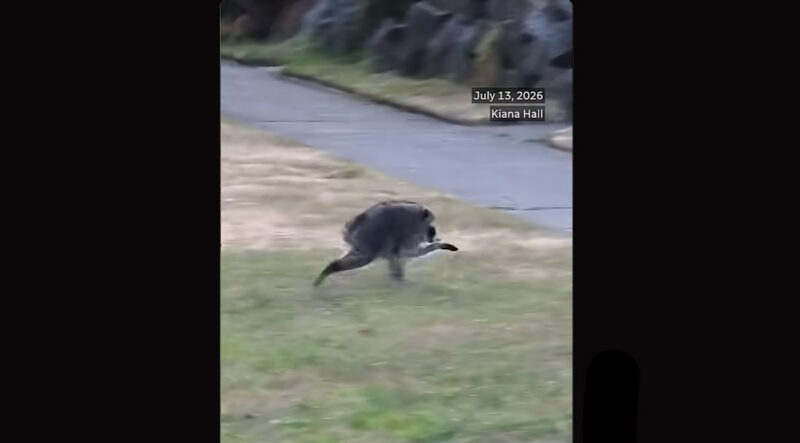
That Jimothy has certainly scurried his way into the hearts of internet denizens.
The collective social media cooing and escapist ruminations over a raccoon from Seattle’s Ballard neighbourhood have become a panacea for people trying to flee the dumpster fire that is the 24-hour news cycle.
His Gollum-esque skitter across the sun-parched lawn and up the stone steps is comical. Kiana Hall captured it, but folks in the neighbourhood had already spotted him with his siblings earlier. Her first reaction was one of tickled curiosity.
“What am I looking at?”
Although comparisons to Danny DeVito have been aplenty on social media, I find him more of a Peter Lorre type. I don’t know if that dates me, but my excuse is I’ve worked as an entertainment reporter.
Still, when I first saw Jimothy and learned of his short-spine affliction, my mind immediately went to those viral videos on YouTube or Reddit showing some sort of small gnomish creature, where the narrator pulls a folkloric reference out of their hat.
Is he a duende? Is he a gahonga? Or could he even be — and I’m reaching here — a gumberoo? Yes, I know he’s a raccoon, but this is exactly how folklore begins. Ikea Monkey happened 14 years ago here in the Greater Toronto Area, and we’re still talking about the stylish simian.
Washington State is the land where Lewis, Clark and Sacagawea, with baby Jean Baptiste Charbonneau, explored the mountains. Those same mountains lumberjacks axed their way through, and of course some eventually got shanghaied from Seattle and woke up as sailors, exploring lore of a different type.
The gumberoo is endemic to lumberjack folklore: a large, skinless black creature with a build similar to a black bear. And this is where we can tie in some of the cryptid lore from the surrounding region.
You see, we fill in the gaps of misunderstanding with what we do understand. If sailors from Christopher Columbus’s crew mistook dugongs and manatees for mermaids, then surely people made the jump from a short-spined raccoon to a duende. An accidental sighting of a swimming moose becomes Caddy. A furry bag of bones fresh from hibernation suddenly becomes a Sasquatch.
And believe me, those photos of bears fresh from their wintry dens do conjure up images of Bigfoot. My colleague from my day job knew I had a keen interest in cryptids, so she showed me a collection of photos of bears emerging from their dens. They’re grotesque, uncanny and strangely look like a fur-clad heroin-chic model after an evening bender in 1990s New York.
Post-Versace parties aside, Jimothy reminds me that anything abnormal can quickly turn into flights of fancy and eventually become a sideshow grift in a travelling circus.
Take any number of people who suffered from hypertrichosis or ichthyosis. How many of them became the Monkey Girl (Percilla Bejano) or the Alligator Boy (Emmitt Bejano) of their region? Heck, John Merrick is still haunting our history textbooks with his Proteus syndrome.
The thing is, animals suffer from the same malformations and subsequent misidentifications. Coyotes with mange become chupacabra. A cheetah with a recessive gene mutation becomes the King Cheetah. And of course, Appalachia’s Not Deer comes from white-tailed ungulates suffering from chronic wasting disease.
It’s perfectly fine to have fun at Jimothy’s expense. To coo and show empathy for the poor critter, much like we do with cat videos where the feline has cerebellar hypoplasia. But let’s keep it at that and not let ourselves think Seattle is being invaded by a pack of surly duende.
Save our skins with logic, as it were.