
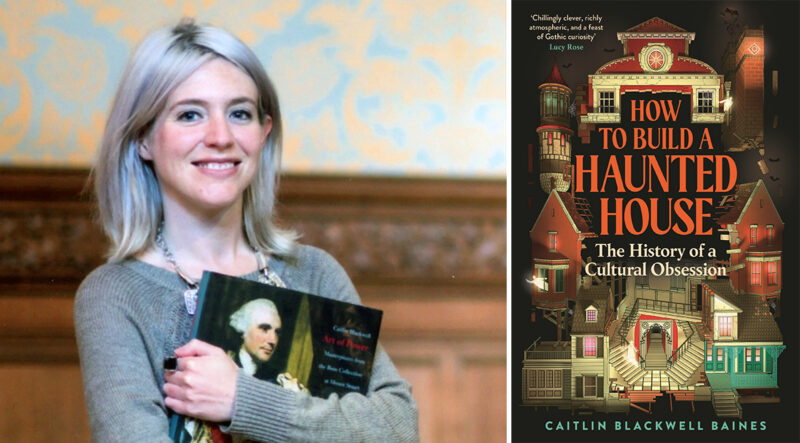
Why are ghost stories connected to certain types of houses? Why do real-life abodes often resemble something from the worlds of Edgar Allan Poe or M.R. James?
For Canadian expat Caitlin Blackwell Baines, the question of why the West’s haunts tend to be domestic spaces was what led her to write How to Build a Haunted House: The History of a Cultural Obsession.
Baines was born in Toronto before moving to London, Ontario, at the age of three.
It wasn’t until her master’s studies that she crossed the Atlantic to attend the Courtauld Institute of Art in 2008. She later earned her doctorate from the University of York in 2014. A self-described “complete history nerd,” she has long loved castles, stately homes and all manner of gothic architectural inspirations.
Still, Canada does not play a major role in her book. There is a North American element, including a brief concluding chapter mentioning that Canada has its share of haunted houses, but Baines focused her thesis on the roots of the haunted house tradition.
“It just wasn’t part of my remit because I was focusing on what I considered the origins of the classic haunted house being in Britain,” she said, adding that one of literature’s first forays into the gothic haunted house was Horace Walpole’s The Castle of Otranto. Walpole wrote the story after completing his home, Strawberry Hill House.
“You go to a certain environment and feel that,” she said of such locations.
Even though she studied art and architecture, she was always drawn to old places that may or may not be haunted. In other parts of the world, hauntings may be associated with forests, lakes or roads, but in Britain and North America, they are often tied to houses.
“I love old houses. I’m always fascinated by this,” she said during a late-April Zoom conversation. “Every time I went to an old house, I always thought, ‘Ooh, I wonder if it’s haunted,’ even though I don’t necessarily believe.”
Believe? Baines admitted she has never had a firsthand paranormal experience, so her skepticism is evident. Still, a few moments at certain locations have given her pause.
She has visited several atmospheric sites in the U.K., but it was during a visit to the Myrtles Plantation in St. Francisville, La., that she experienced something uncanny.
“I went there already having read a lot about it, the classic ghost story that’s attached to it,” she recalled, referring to the legend of Chloe. “There’s no evidence that she ever existed, so I wasn’t that scared.”
She travelled to Louisiana with her husband as part of a longer road trip. They had been staying at a boutique hotel and dining at a fancy restaurant, so their minds were elsewhere. But when she went to bed that night, she woke around 3 a.m. with the sensation that someone was standing over her, even though she could not see anyone.
“It’s the only time anything like that has ever happened at night, and I started being quite frightened. Then I heard the sound of crying,” she said. “Then I said, ‘Help me! Help me!’ and my husband leaned over and said, ‘You’re just having a dream.’”
That was enough for Baines to return fully to the waking world, but the experience stayed with her.
“You go to these places knowing it’s a plantation house. It’s got a history of torture, death and slavery, all those sorts of things,” she said. “So, it’s embedded in your mind.”
How to Build a Haunted House: The History of a Cultural Obsession is available through publisher Profile Books, local bookstores and online retailers.